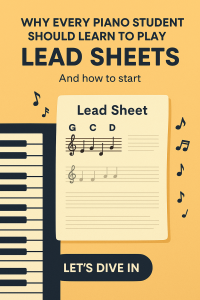

If your piano students are stuck in the “read the notes and repeat” rut, lead sheets might just be the breakthrough you’ve been looking for. Far from just a jazz trick or a pop shortcut, lead sheets are a powerful teaching tool that builds creativity, theory fluency, performance flexibility, and—most importantly—musical independence.
In this post, we’re diving into everything piano teachers need to know about teaching lead sheets, how to introduce them, why they matter, and what happens when students master this skill.
What Are Lead Sheets?
A lead sheet is a simplified piece of music that includes:
- A melody line (written in standard notation)
- Chord symbols (above the staff)
- Occasionally, lyrics (beneath the melody)
Instead of telling the student exactly what to play in every hand, lead sheets leave room for interpretation and arrangement. The student decides what to do with the chords, rhythm, and accompaniment style.
Lead sheets are everywhere—jazz charts, pop hits, worship music, Broadway tunes—and they offer students a taste of real-world musicianship.
The Benefits of Teaching Lead Sheets
1. Creativity and Improvisation
Teaching lead sheets empowers students to experiment, explore, and play with sound. As Andrea Dow puts it, lead sheets are a “secret weapon” because they make music lessons fun and flexible. There’s just enough structure to guide students—but not so much that it stifles creativity.
Students:
- Try out different left-hand patterns
- Embellish melodies
- Make creative decisions
- Develop their musical voice
Lead sheets teach students how to make musical choices—a skill that note-reading alone often leaves behind.
“Lead sheets are a springboard for improvisation.” – Bradley Sowash
2. Hands-On Music Theory That Actually Sticks
When students build a song from melody + chords, they’re living inside music theory—not memorizing it in the abstract.
With lead sheets, they learn:
- Chord identification (majors, minors, sevenths, etc.)
- Common chord progressions (like I–V–vi–IV)
- Harmonic rhythm (how chords move)
- Phrase structure and form (AABA, 4-bar phrases, etc.)
Nicola Cantan calls this approach “wonderful fodder” for hands-on theory. Students see chord patterns repeat. They hear how harmony supports melody. And they apply theory in real-time.
It’s not just learning—it’s understanding.
85% of piano teachers surveyed said lead sheets increased students’ overall musical understanding. – Susan Deas, 2009
3. Performance Skills and Real-World Readiness
Lead sheets train students to:
- Build chords quickly
- Navigate patterns fluently
- Accompany singers and other instruments
- Adapt to various styles (jazz, pop, Latin, folk)
They also develop rhythm confidence, steady pulse, and the ability to voice chords musically—all key ingredients in live performance.
And let’s be honest: If your student gets asked to play at church or jam with friends, chances are they’ll be handed a lead sheet, not a classical score.
90% of teachers agree that lead sheet proficiency is useful in multiple musical settings. – Deas, 2009
4. Lifelong Musical Independence
Students who can read lead sheets can:
- Play songs they love, without sheet music
- Jam with friends or bandmates
- Write their own arrangements
- Compose their own music
- Continue playing long after lessons end
It’s no surprise that 77% of teachers say lead sheet skills help students keep playing after formal study ends. Why? Because they know how to figure things out on their own.
Lead sheets create functional, real-world musicians—not just recital players.
“Lead sheets give students the keys to unlock music on their own.” – Susan Deas
5. Genre Versatility + Ensemble Confidence
Lead sheets are a universal language in:
- Jazz (“Autumn Leaves,” “Take the A Train”)
- Pop (“All of Me,” “Clocks,” “Hallelujah”)
- Rock (“Stairway to Heaven”)
- Latin and folk genres
They also foster ensemble skills:
- One student plays chords
- One plays melody
- Another adds a bassline or improvisation
Suddenly, they’re making music together—with no full score required. That’s collaboration. That’s musical maturity.
How to Teach Lead Sheets (Without Overwhelm)
Start Simple:
- Choose a lead sheet with basic chords in C or G major
- Teach the melody by ear or reading
- Break down each chord symbol + help students play them
- Slowly combine melody and chords
Encourage Experimentation:
- Add left-hand rhythms
- Try different chord voicings
- Embellish the melody
Celebrate Wins:
- Play for a parent
- Record a version with your student’s personal arrangement
- Let them teach a sibling or friend
Looking for an AI Shortcut?
I’ve got you covered. 💡
If you want a done-for-you AI prompt that helps you plan an entire lead sheet lesson, I’ve written one for you.
👉 Click here to grab the full tutorial + prompt
Want to see how it works in action?
🎧 Here’s how I used it to teach ‘Clocks’ by Coldplay.
Final Thoughts
Lead sheets aren’t just for jazz cats or pop enthusiasts. They’re a core skill for today’s musicians.
They create students who:
- Think for themselves
- Understand music deeply
- Play flexibly
- Stay musically active long after their last formal lesson
And as a teacher? You get to watch that freedom unfold.
Want more?
🎧 Tune into the TopMusicAI Podcast for more teaching strategies that mix tech, heart, and studio reality.
🎁 Grab more AI prompts to support your teaching at melodicmentors.com/ai-prompts